
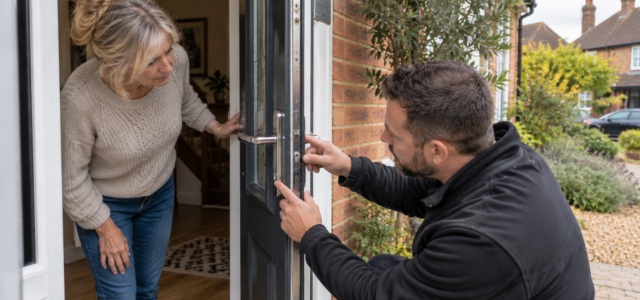
If your UPVC door locks but the handle still feels loose, floppy or has excessive movement, something within the handle or locking mechanism may be starting to wear.
The fact that the door still locks can make the problem seem relatively minor. However, a change in how the handle feels is often an early indication that a component is no longer operating as it should.
Getting it checked before the mechanism fails completely can help avoid being left with a door that won’t lock or open properly.
Why Does a UPVC Door Handle Become Loose?
A UPVC door handle operates several components every time the door is opened, closed or locked.
Depending on the locking system, excessive movement could be caused by:
- Loose or worn handle components
- A worn spindle
- Wear inside the handle mechanism
- A developing gearbox fault
- Wear within the multi-point locking mechanism
- Excessive resistance caused by poor door alignment
The exact cause cannot always be identified from the handle alone because several parts of the locking system work together.
Could It Just Be the Door Handle?
Yes, sometimes the problem is limited to the handle assembly.
Handles experience considerable use over the lifetime of a door. Internal components can wear, and fixings can loosen.
However, replacing the handles without checking the mechanism isn’t always the right solution.
If excessive resistance elsewhere in the locking system has contributed to the wear, fitting new handles without addressing the underlying problem may simply allow the fault to develop again.
What Does a Failing Gearbox Feel Like?
The gearbox sits at the centre of many UPVC multi-point locking systems and transfers movement from the handle and key to the locking mechanism.
As it begins to wear, symptoms can include:
- Excessive movement in the handle
- A handle that feels different from normal
- Difficulty lifting the handle
- A handle that doesn’t return correctly
- Clicking or grinding noises
- Intermittent problems locking the door
- The key becoming more difficult to turn
A gearbox can deteriorate gradually, so the door may continue to work for some time before a more obvious failure occurs.
Check How the Handle Behaves With the Door Open
The behaviour of the locking system when the door is open can provide useful clues.
If the handle operates normally with the door open but becomes loose, stiff or difficult when the door is closed, alignment may be placing additional strain on the locking mechanism.
UPVC doors commonly use several locking points around the edge of the door. These need to line up correctly with the corresponding keeps in the frame.
If they don’t, additional force may be needed to operate the handle, which can accelerate wear elsewhere in the system.
Should You Keep Using a Loose Handle?
A small amount of movement doesn’t necessarily mean the lock is about to fail immediately, but a noticeable change shouldn’t be ignored.
Continuing to force or repeatedly operate a faulty handle can potentially place additional stress on the:
- Handle assembly
- Spindle
- Gearbox
- Multi-point locking mechanism
- Cylinder
If the handle suddenly becomes significantly looser or stops operating the locking points properly, the door should be checked.
Can a Locksmith Repair a Loose UPVC Door Handle?
Yes. A locksmith can inspect the handle and the components it operates to determine where the excessive movement originates.
This can include checking the handles, spindle, cylinder, gearbox, multi-point mechanism and alignment of the door.
Depending on the fault, it may be possible to repair or replace the affected component without replacing the complete locking system.
For another common handle-related fault, see our guide to Composite Door Handle Won’t Lift in Marlow.
You can also find more information about ASAP Locksmiths’ residential locksmith services.
UPVC Door Lock Repairs in Marlow
If your UPVC door still locks but the handle has become loose or unusually floppy in Marlow, it is worth finding out why.
The fault may be confined to the handle, but it could also be an early sign of wear within the spindle, gearbox or multi-point locking mechanism.
Having the locking system inspected before it fails completely can help restore normal operation and keep the door locking reliably.

Comments are closed.