
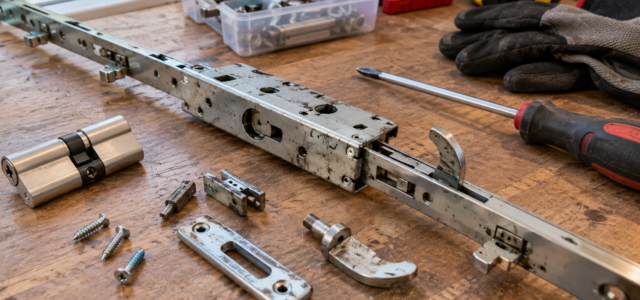
A UPVC door that won’t unlock properly can be frustrating, particularly when the key turns and the handle appears to operate normally, but the door remains secured.
In some cases, the problem is caused by a multi-point locking mechanism that isn’t releasing completely. One or more locking points may remain engaged, preventing the door from opening as expected.
For homeowners in Twyford, understanding the warning signs can help prevent a developing locking fault from becoming a more serious problem.
How Does a UPVC Multi-Point Lock Work?
Most modern UPVC front and back doors use a multi-point locking system.
Instead of securing the door at just one point, the mechanism operates several locking components positioned along the edge of the door.
Depending on the design, these can include:
-
Hook bolts
-
Roller cams
-
Deadbolts
-
Central locking gearboxes
-
Connecting rods and internal components
When the handle and key are operated, these components should move together to secure or release the door.
If one part of the system fails, the locking mechanism may no longer operate correctly.
Why Would a Multi-Point Lock Fail to Release?
There are several possible causes.
1. A worn or damaged gearbox
The gearbox is responsible for transferring movement from the handle and cylinder to the wider locking mechanism.
Over time, internal components can wear or break.
You might notice that the handle moves normally but the locking points don’t fully retract.
Other warning signs include unusual clicking noises, inconsistent handle movement or increasing resistance when operating the lock.
2. A locking hook remains engaged
Multi-point locks often use hooks that move into keeps fitted to the door frame.
If a hook becomes damaged or the mechanism controlling it fails, it may remain partially engaged even when the door is unlocked.
This can prevent the door from opening normally.
A locksmith can inspect the mechanism to determine whether the problem involves an individual locking point or the wider system.
3. Internal mechanism wear
A multi-point lock contains several moving components that work together.
With regular use, these components can gradually deteriorate.
If an internal connection becomes worn or damaged, the movement of the handle may no longer be transferred correctly along the full locking strip.
This can cause some locking points to release while others remain engaged.
4. Door alignment problems
Not every locking fault is caused by a broken mechanism.
If the door has moved slightly out of alignment, the locking points may become trapped against their corresponding keeps.
This can make the door difficult to unlock or open, particularly when additional pressure is placed on the locking system.
A locksmith can assess whether the fault requires an adjustment or a mechanical repair.
For related problems, see our guide to UPVC doors that won’t lock properly in Tilehurst.
Signs Your Multi-Point Lock Is Starting to Fail
A locking mechanism doesn’t always stop working without warning.
Common symptoms include:
-
The door becomes increasingly difficult to unlock
-
The handle feels stiff or moves inconsistently
-
The key turns but the door remains secured
-
Clicking or grinding noises come from the mechanism
-
The door needs additional pressure before opening
-
The locking points don’t appear to retract completely
These symptoms should be investigated before the mechanism fails entirely.
Why You Shouldn’t Force a Stuck Locking Mechanism
When a UPVC door refuses to open, it can be tempting to pull harder on the handle or repeatedly turn the key.
However, forcing the mechanism may cause further damage.
Additional pressure can affect the gearbox, locking strip, cylinder and other connected components.
A professional locksmith can identify where the resistance originates and determine the appropriate repair without unnecessarily damaging the door.
Can a UPVC Multi-Point Lock Be Repaired?
Yes, many faults can be repaired without replacing the entire door.
The appropriate solution depends on the condition and design of the locking mechanism.
Possible repairs include:
-
Replacing a faulty gearbox
-
Repairing or replacing damaged locking components
-
Adjusting the locking mechanism
-
Correcting alignment problems affecting the lock
-
Replacing a failed multi-point locking strip when necessary
A locksmith should diagnose the fault before deciding which components require attention.
For more information about related faults, read our article on broken lock mechanisms in Caversham.
Is It Better to Repair or Replace the Mechanism?
This depends on the nature of the fault.
If the problem is limited to a replaceable gearbox, repairing the existing locking system may be the most practical solution.
However, if the complete mechanism is badly worn, damaged or no longer functioning reliably, replacement may be necessary.
The aim is to restore dependable locking and unlocking without replacing components unnecessarily.
UPVC Multi-Point Lock Repairs in Twyford
If your UPVC multi-point lock isn’t releasing properly in Twyford, the problem could involve the gearbox, locking hooks, internal mechanism or door alignment.
ASAP Locksmiths provides residential locksmith services throughout Reading and the surrounding areas, including repairs to UPVC and composite door locking systems.
A professional inspection can identify the underlying fault and establish whether an adjustment, component repair or replacement is required.
For assistance with a faulty door locking mechanism, contact ASAP Locksmiths.

Comments are closed.